


 03 May 2026
 IAPC
IAPC 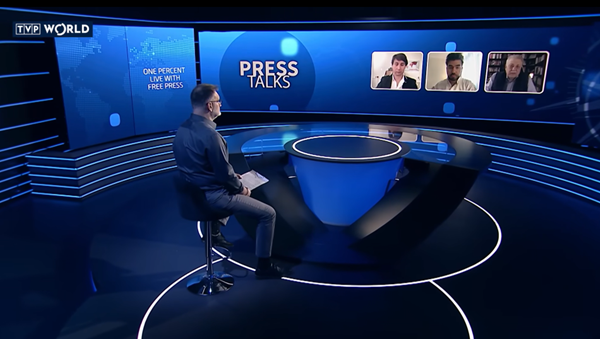
For decades, the public shaming of governments that harassed journalists was part of the international language of accountability. But according to a panel of global media experts, that restraint is weakening. Attacks on journalists are no longer treated only as scandals. Increasingly, they are used as political strategy.
The warning came during a special edition of Press Talks, hosted by Jarosław Włodarczyk, Secretary General of the International Association of Press Clubs, to mark International Press Freedom Day, with Waiel Awwad, President of the IAPC and veteran foreign correspondent; Szabolcs Panyi, Hungarian investigative journalist and editor at VSquare and Direkt36; and Pavol Szalai, Prague-based director for Reporters Without Borders.
The discussion followed the publication of the 2026 World Press Freedom Index, which pointed to a sharp global decline: press freedom has reached its lowest level in 25 years, and only 1 percent of the world’s population now lives in countries where press freedom is classified as “good.”
“It is no longer a matter of shame to attack journalists,” said Pavol Szalai, Prague-based director for Reporters Without Borders. “It is a strategy.”
The panelists described a combined technological and legal assault on independent journalism. In the digital sphere, authoritarian leaders and populist movements use social media to bypass traditional scrutiny, speaking directly to audiences in political bubbles where facts are rarely checked and opposition can be easily dismissed. In the legal sphere, governments increasingly use national security legislation, surveillance tools and abusive lawsuits to pressure reporters and weaken independent newsrooms.
Szalai called this trend “lawfare”: the use of law not to protect rights, but to suppress them. SLAPP lawsuits, he noted, are often designed not to establish truth, but to exhaust journalists financially and psychologically.
The human cost of this shift was reflected in the experience of Szabolcs Panyi, a Hungarian investigative journalist who has reported on national security, foreign policy and Russian and Chinese influence. Panyi described how journalists can move from reporting on power to becoming targets of power — through surveillance, smear campaigns and accusations framed around national security.
Beyond Europe, the crisis can be even deadlier. Waiel Awwad, President of the International Association of Press Clubs and a veteran foreign correspondent, said that in conflict zones journalists are increasingly treated not as witnesses, but as threats. He also warned of growing “information fatigue,” in which the speed and volume of false news leave audiences exhausted and less responsive to verified reporting.
Yet the panelists argued that silence would be the most dangerous response. Citing the recent release of Polish journalist Andrzej Poczobut from a Belarusian prison, they said international attention and professional solidarity remain essential. Public pressure can raise the political cost for regimes that imprison, smear or intimidate journalists.
As the program concluded, the warning was clear: the ultimate target of these attacks is not only the media. It is the public’s right to know. When that right is weakened, power becomes much harder to control.